1 / 18
Dallas AI Monthly · January 2026

Scaling GenAI with Confidence

Moving Beyond "Guardrails" to Deterministic Remediation

Speaker
Cyril Gorlla
Role
Founder & CEO, CTGT
Date
January 15, 2026
Part I

A Brief History of Learning

From the Perceptron to today's frontier models, and the persistent question of control.

New York Times article from July 13, 1958
The New York Times, July 13, 1958 · "Electronic 'Brain' Teaches Itself"
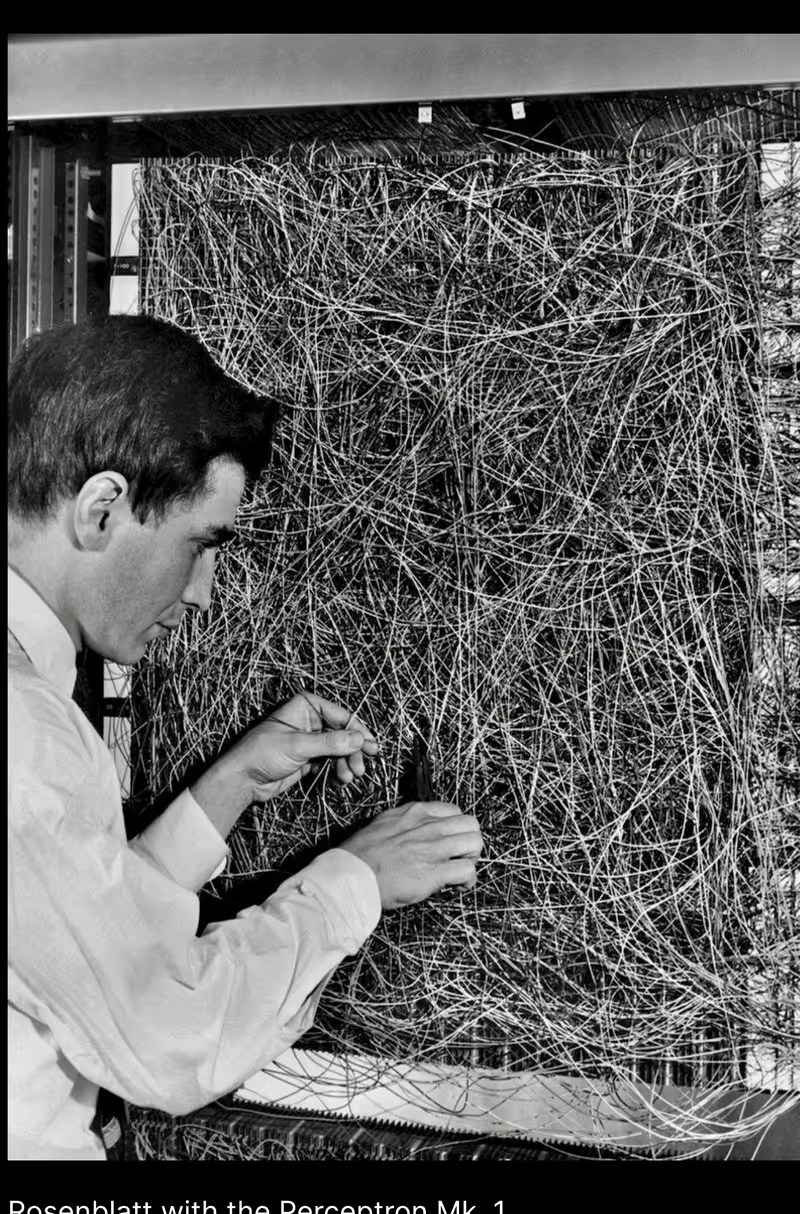
Frank Rosenblatt with the Perceptron Mk. 1
Frank Rosenblatt working on the Perceptron Mk. 1
!
The constant through 70 years: We've always struggled to understand and control what these systems learn. The "black box" problem isn't new, but the stakes have never been higher.
The Pioneers

From Winter to Renaissance

The 1969 "Perceptrons" critique by Minsky & Papert triggered an AI Winter. Decades later, Rumelhart and Hinton revived neural networks with backpropagation.

Perceptrons book by Minsky and Papert
Minsky & Papert
"Perceptrons" (1969) · Triggered the AI Winter
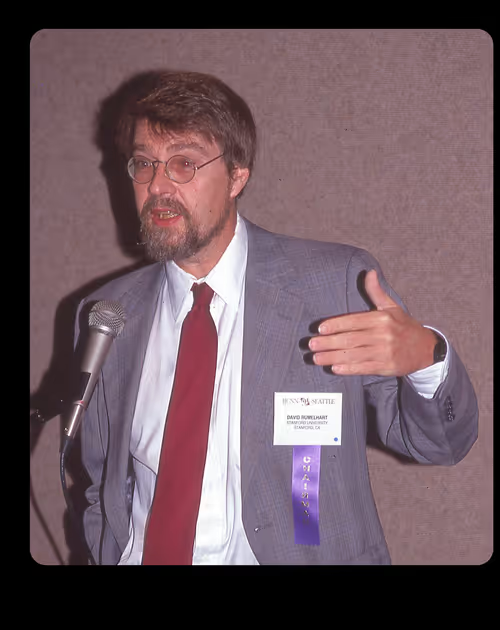
David Rumelhart
David Rumelhart
Backpropagation pioneer, Stanford

Geoffrey Hinton
Geoffrey Hinton
"Godfather of AI" · Deep Learning
1958
Perceptron invented
1969
AI Winter begins
1986
Backpropagation paper
2017
Transformers emerge
Today
$1.3T projected spend
The CTGT Story

From Research to Production

What started as university AI research became the foundation for enterprise-grade AI governance.
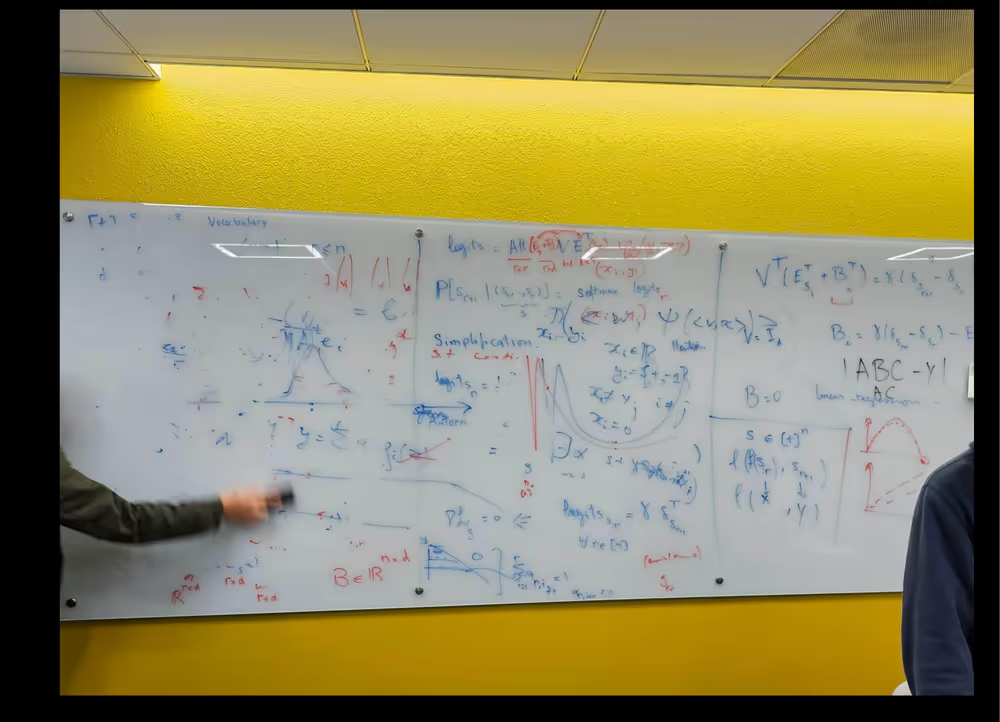
CTGT research whiteboard 2024
Early 2024 · Working on deterministic model control at UCSD
2024
Stanford AI Lab Research
2025
Forrester AI Vision Report, InfoWorld Technology of the Year Finalist
Today
Scoped for 10M+ daily messages
Recognition

Exponential Growth

From research project to industry recognition. CTGT's approach to AI governance has captured attention across the tech landscape.
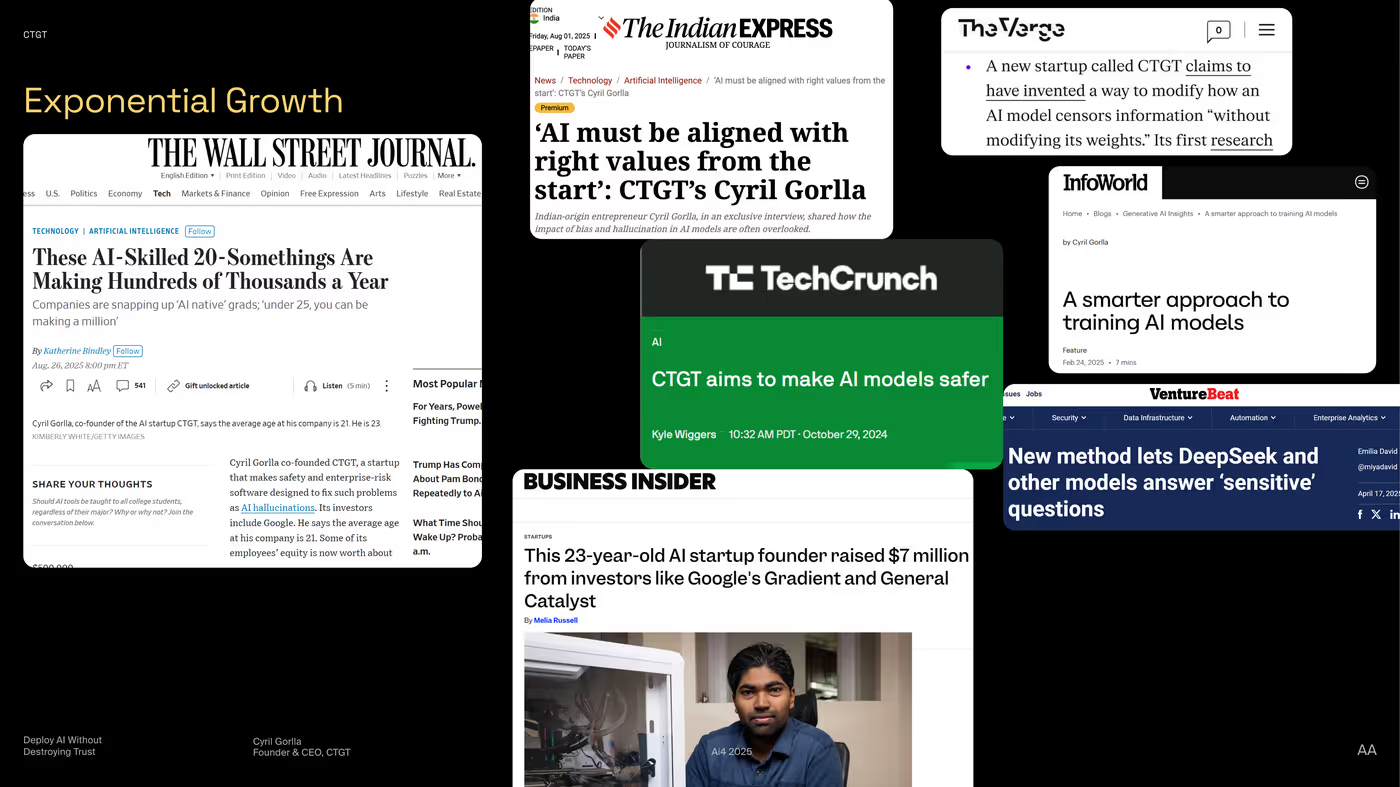
Press coverage collage
Part II

Through a Glass, Darkly

The fundamental challenge: AI models are probabilistic black boxes. We can observe inputs and outputs, but the reasoning process remains opaque.

📄
Your Policies
& Documents
💬
Model Output
? Reliable ?

"It is a profound and necessary truth that the deep things in science are not found because they are useful; they are found because it was possible to find them."

— J. Robert Oppenheimer

The Challenge

The Black Box Trust Gap

Enterprises are stuck in "Pilot Purgatory." Fortune 500s in finance, media, and healthcare cannot move LLM projects to production because models are inherently probabilistic.

80%
of enterprise AI projects stalled in pilot phase
Gartner 2024
30%
GPT-4o hallucination rate per OpenAI Technical Report
OpenAI 2024
900+
Policies in SEC Reg BI alone that models struggle to follow
Regulatory Reality
Why Mitigations Fail

The Limits of Conventional Approaches

Prompt Engineering

Fragile at scale. Models fail 30%+ of rules when context exceeds 900 policies. Instructions get "forgotten" in long contexts.

Fine-Tuning

Expensive & brittle. $100K+ per iteration. Catastrophic forgetting. Requires retraining when policies change.

RAG Pipelines

Context pollution. RAG often degrades accuracy by introducing noise. On Claude Sonnet: 94% base → 85% with RAG.

Binary Guardrails

Kill utility. Current guardrails only block outputs; they don't fix them. You either get an unusable response or a compliance violation. There's no middle ground.

Part III

Opening the Black Box

CTGT provides a deterministic enforcement layer, not another probabilistic guardrail. We compile business rules into navigable knowledge graphs that force model compliance.

01 · INGEST
Policy Compilation
Upload unstructured documents (style guides, legal codes, SOPs). Our engine compiles them into a proprietary Knowledge Graph with discrete, fungible rules.
02 · ENFORCE
Active Remediation
Our sidecar intercepts model outputs in real-time, forces deterministic graph traversal, and rewrites non-compliant content before it reaches users. <10ms latency.
03 · AUDIT
Defensible Trail
Every remediation is logged with line-by-line attribution back to source policies. Complete traceability for compliance reviews and regulatory audits.
The key insight: Instead of asking "did the model get it right?", we verify every claim against the source of truth and remediate in real-time. Deterministic, not probabilistic.
Verified Performance

HaluEval & TruthfulQA Benchmarks

Independent benchmark results across frontier and open-source models. Note how RAG often degrades performance while CTGT consistently improves it.

ModelTypeBase+ RAG+ CTGTΔ vs Base
Claude 4.5 SonnetFrontier93.77%84.88%94.46%+0.69%
Claude 4.5 OpusFrontier95.08%90.87%95.30%+0.22%
Gemini 2.5 Flash-LiteFrontier91.96%79.18%93.77%+1.81%
GPT-120B-OSSOSS21.30%63.40%70.62%+49.32%
!
Critical finding: RAG adds noise, CTGT adds signal. On Claude Sonnet, RAG drops accuracy from 94% to 85%. CTGT maintains and improves baseline performance.
The Breakthrough

Small Models, Frontier Performance

CTGT's Policy Engine enables smaller, cost-efficient models to match or exceed the base performance of the most expensive frontier systems.

96.5%
GPT-120B-OSS + CTGT
Open-source model with CTGT governance layer
95.1%
Claude 4.5 Opus (Baseline)
Most advanced frontier model, no CTGT
An open-source model with CTGT exceeds the baseline performance of the most advanced frontier model.
$
Enterprise implications: Organizations can achieve frontier-level reliability with significantly reduced compute costs, critical for deploying AI at scale across regulated industries.
Policy-Driven Precision

Real-World Examples

EXAMPLE 01Multi-Step Reasoning

Query: "Where did the Olympic wrestler who defeated Elmadi Zhabrailov later go on to coach wrestling at?"

BASELINE

"The context does not mention where Kevin Jackson went on to coach wrestling."

+ CTGT

Correctly traces "he" to Kevin Jackson → Iowa State University

EXAMPLE 02Error Tolerance

Query: "In what year was David Of me born?" (typo for "David Icke")

BASELINE

"I cannot answer. The text does not contain information about 'David Of me.'"

+ CTGT

Recognizes typo, maps to "David Icke" → 1952

This is the reliability required for financial compliance, legal review, and healthcare applications.

Part IV

The TCO Revolution

Moving away from fine-tuning, complex prompting, and RAG pipelines doesn't just improve accuracy. It dramatically reduces Total Cost of Ownership.

LEGACY APPROACH

$2-5M+
Annual maintenance cost
  • Fine-tuning iterations: $100K+ each
  • RAG infrastructure overhead
  • 1-2 week policy update cycles
  • Engineering maintenance burden

WITH CTGT

20-40%
Engineering TCO reduction
  • No fine-tuning required
  • Minimal infrastructure footprint
  • Real-time policy updates
  • 10x engineering velocity

ADDITIONAL BENEFITS

99.9%+
Policy adherence achieved
  • Eliminated risk windows
  • Full audit trail
  • Model-agnostic deployment
  • Weeks to production, not months
Applications

Where This Matters

Financial Services

SEC Reg BI compliance, fiduciary duty enforcement, investment advice validation

900+ policies enforced in real-time

Legal & Compliance

Contract review, regulatory filing validation, due diligence automation

Line-by-line audit attribution

Healthcare & Life Sciences

Clinical documentation, HIPAA compliance, medical information accuracy

Zero tolerance for hallucination
Common thread: Industries where mistakes have consequences: regulatory fines, legal liability, patient safety. These are the use cases where probabilistic outputs are unacceptable.
Interactive

See It In Action

Experience deterministic remediation yourself at playground.ctgt.ai

What You'll See

  • Upload any policy document
  • Watch it compile into knowledge graph
  • Query the model
  • See real-time remediation in action
  • Trace every claim to source

Try These Scenarios

  • Compliance policy enforcement
  • Style guide adherence
  • Factual claim verification
  • Multi-step reasoning validation
  • Error tolerance and recovery
playground.ctgt.ai
No signup required · Live demo environment
Engagement Model

The Path Forward

PHASE 1
Prove
Controlled Pilot
  • Scope initial use case
  • Benchmark accuracy & TCO
  • Prove deployment model
PHASE 2
Expand
Cross-Division
  • Roll out to adjacent units
  • Add new policy sets
  • Prove multi-domain value
PHASE 3
Scale
Enterprise "AI Firewall"
  • Central governance layer
  • Model-agnostic control
  • Full audit capability
The goal: A single, independent platform to secure, control, and audit all AI activity across the enterprise. Deterministic governance that scales.
Summary

Key Takeaways

1

The Black Box Problem is Solvable

Deterministic enforcement layers can open the black box through active verification and remediation, not interpretability research.

2

RAG Isn't the Answer

Context pollution often degrades model performance. Policy-driven verification improves accuracy without adding noise.

3

Small Models Can Beat Big Ones

With proper governance, open-source models can exceed frontier model baselines, dramatically reducing TCO at scale.

4

Production is Possible Now

Pilot purgatory is a choice, not an inevitability. Deterministic governance enables confident enterprise deployment today.

CTGT

Deploy AI Without Destroying Trust
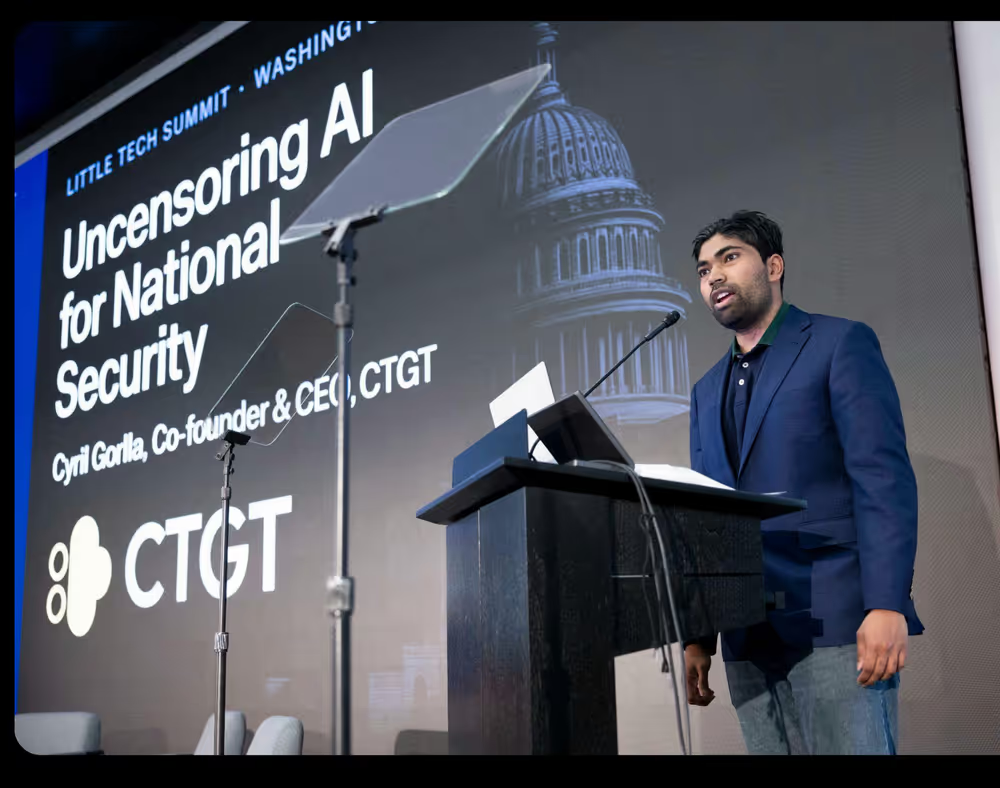
Cyril Gorlla presenting at Little Tech Summit
Event
Dallas AI Monthly
Date
January 15, 2026
Location
Dallas College Brookhaven